
The Netherlands is not a poor country. That is still true. And yet, in 2024, 551,000 people lived below the poverty line. That is 3.1 percent of the population, up from 2.7 percent the year before. After five years of steady decline, poverty rose again. Not dramatically, not explosively, but enough to matter. These are not abstract figures. They sit closer to everyday business life than many entrepreneurs realise.
Statistics Netherlands published these numbers calmly, as it always does. The causes are explained in policy language: the energy allowance ended, support measures faded, purchasing power shifted. But behind those explanations sits a quieter reality that many micro and small business owners recognise immediately. Costs remained high, buffers were thin, and income did not move at the same pace as risk.
Consider a self-employed café owner in a medium-sized Dutch town. Not a struggling business, not a booming one either. Energy costs doubled in recent years, then stabilised at a higher level. Rent did not go down. Insurance rose. The owner paid herself a modest income, just enough to keep things going. On paper, she was working. In reality, she was absorbing shocks that employees around her did not see. When the energy allowance disappeared, it did not affect her directly, but it affected her customers. Fewer coffees ordered, fewer lunches, slightly shorter visits. Nothing dramatic. Just enough to feel it at the end of the month.
This is where the poverty figures deserve careful reading. Poverty is not measured by emotion or lifestyle. It is calculated after housing, energy, health insurance, and deductibles are paid. What remains must cover food, clothing, and the ability to participate in normal social life. For a single person in 2024, that threshold was about 1,600 euros per month. For a couple with children, it rose quickly. Many working people sit just above these lines, officially not poor, but structurally exposed.
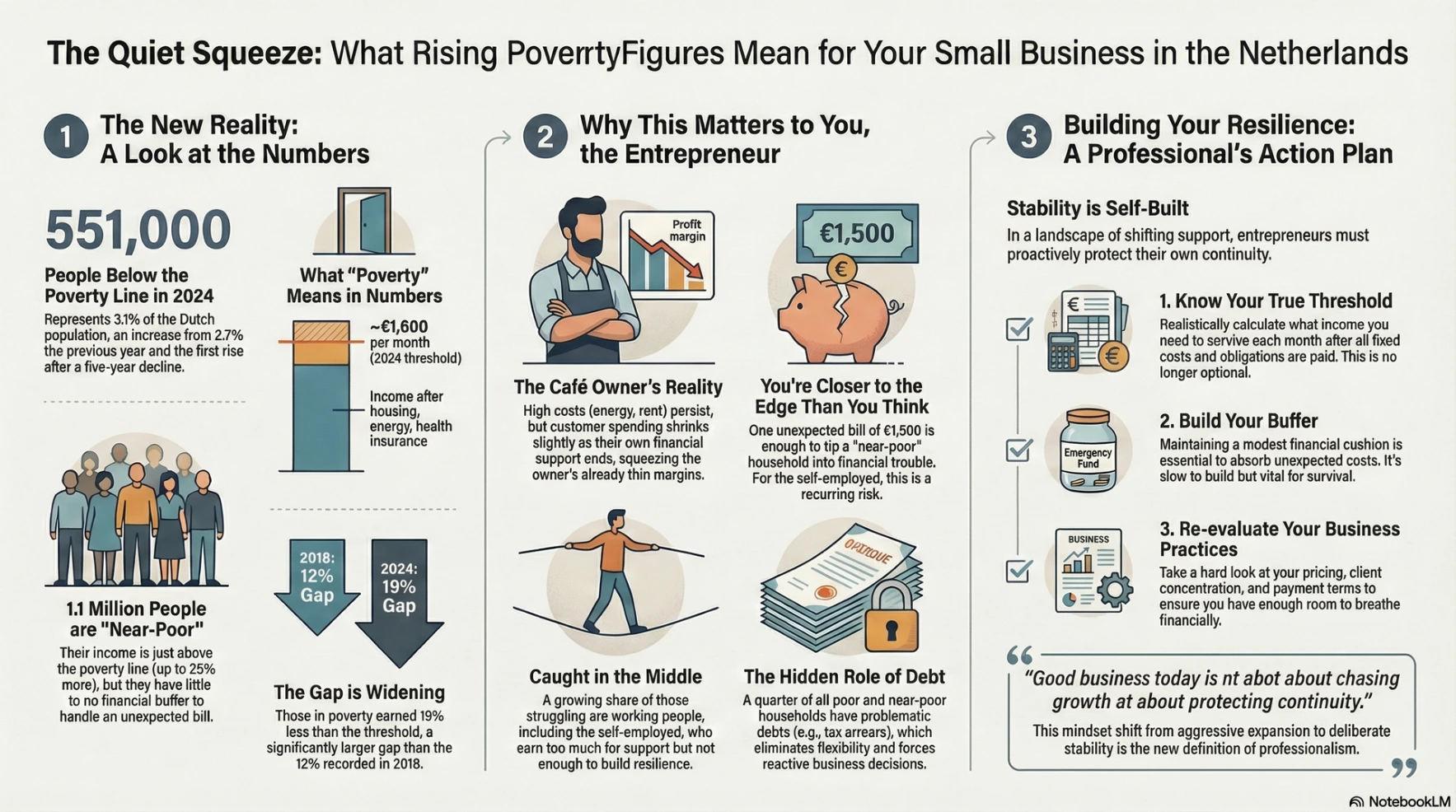
The data shows this clearly. In addition to those officially poor, 1.1 million people are considered near-poor. Their income is up to 25 percent above the poverty line, but they have little or no financial buffer. One unexpected bill of 1,500 euros is enough to tip the balance. A broken car, a tax correction, a delayed payment. For many self-employed people, this is not an exception. It is a recurring risk.
What is particularly telling is the income deficit. In 2024, people in poverty earned on average 19 percent less than the poverty threshold. That gap was only 12 percent in 2018. The distance between stability and vulnerability has grown. Measures taken in recent years helped many benefit recipients move above the poverty line. That is good news. But it also means that a larger share of those left behind are working people, including the self-employed. They earn too much for support, but not enough to build resilience.
This is not a moral story. It is a structural one. The system is still largely designed around fixed incomes and predictable contracts. Micro-entrepreneurs operate differently. Income fluctuates, buffers are personal, and risks are absorbed privately. When policy support ends, the impact is uneven. The figures do not shout this. They whisper it.
The situation of children is often used as a moral indicator, and here the numbers remained stable. About 2.8 percent of children live in poverty, unchanged from the year before. But stability does not mean comfort. When you include near-poor families, roughly three children in an average class of thirty grow up in households that regularly struggle to meet normal expenses. For business owners who are also parents, this creates a double pressure. Professional responsibility meets personal vulnerability.
Debt plays a quiet but decisive role. A quarter of all poor and near-poor households have problematic debts. Tax arrears, health insurance backlogs, fines. Once these accumulate, flexibility disappears. Decisions become reactive. Discounts are offered too quickly. Investments are postponed too long. Not because of poor judgment, but because mental space is limited when margins are thin.
What does this mean for the reader running a small company today? Not that collapse is imminent. Not that panic is warranted. The numbers do not support that. But they do suggest something else: the margin for error is smaller than it appears. Many entrepreneurs are operating closer to the edge than their turnover suggests.
Clarity begins with realism. Understanding your true monthly threshold, not just revenue but what remains after fixed costs and obligations, is no longer optional. Neither is maintaining a modest buffer, even if it feels slow and frustrating to build. Pricing decisions, client concentration, and payment terms deserve renewed attention. Not because the economy is hostile, but because it is quietly unforgiving to those without room to breathe.
The poverty figures of 2024 do not describe a society in crisis. They describe a society in transition, where support mechanisms shift and risks are redistributed. For micro and small business owners, this means one thing above all: stability is increasingly self-built. Not through ambition or expansion, but through clarity, restraint, and conscious choices.
The numbers rose quietly. That is precisely why they deserve to be heard. Not as a warning siren, but as a reminder that good business today is not about chasing growth at all costs. It is about protecting continuity, understanding exposure, and leaving just enough space to absorb the unexpected. In times like these, that is not pessimism. It is professionalism.
Paolo Maria Pavan
Co-Founder Xtroverso
Strategic analyst of the Dutch market, Paolo Maria Pavan delivers exclusive insights for Xtroverso clients.
In 2025 he stepped away to focus on other projects, yet remains available on demand for key assignments.
This section decodes economy, social signals, and entrepreneurship through data and patterns the press will not tell you, helping you lead with clarity and direction.