
The latest figures from Statistics Netherlands and Wageningen Economic Research tell a story that will sound familiar to many entrepreneurs, even far beyond the farm. Agricultural income in 2025 is expected to fall slightly to €11.1 billion, about half a percent lower than last year. It is the first decline since 2021. On paper, this may look almost negligible. In real business life, it is anything but trivial. What makes the figure interesting is not the drop itself, but the context: production value is actually rising.
In simple terms, Dutch agriculture will produce more, sell more in euro terms, and still earn less. The total value of agricultural production is expected to grow to €42.1 billion, up 1.8 percent. Yet costs rise faster. Energy, seeds, services, machinery, buildings, depreciation. Add a slightly less favorable balance of subsidies and taxes, and the result is a sector that works harder for thinner margins. If you run a small company, this logic will feel painfully familiar.
Imagine a vegetable grower supplying local wholesalers. The harvest is good. Volumes are up. Warehouses are full. But because supply rises across the board, prices soften. At the same time, energy bills remain stubbornly high, machinery is aging, and replacing it costs more than it did three years ago. The grower is busy from dawn to dusk, invoices go out, turnover looks respectable, yet at the end of the year there is less room to breathe. That is not mismanagement. That is margin pressure.
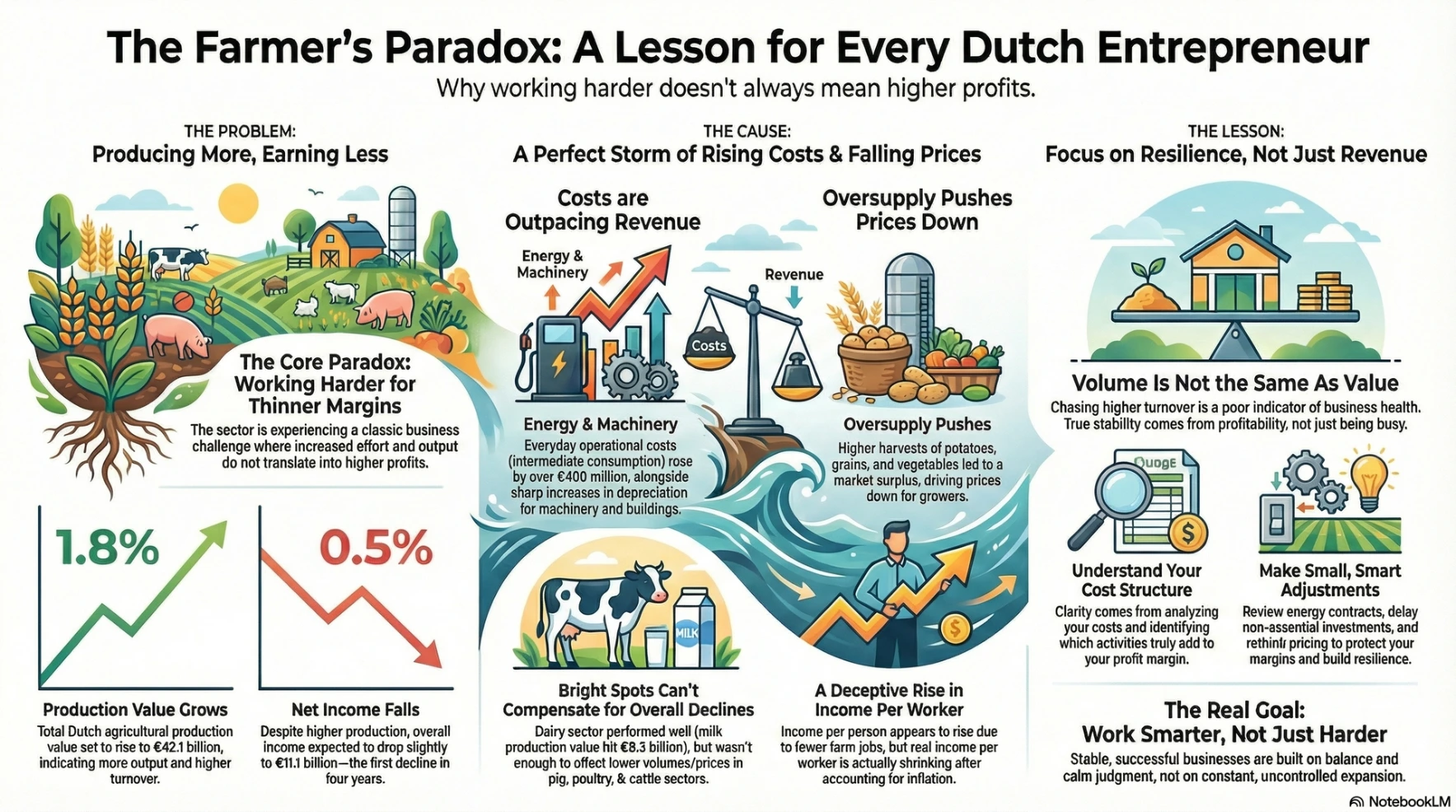
The data shows this clearly. Intermediate consumption, the everyday costs of running production, rises by more than €400 million. Depreciation on buildings and machinery increases sharply as well. Together, these costs grow faster than revenues. The result is a modest but meaningful decline in income. It is a reminder that revenue growth alone is a poor indicator of business health, especially in cost-sensitive environments.
Looking deeper, the picture becomes even more nuanced. Dairy stands out as a relative bright spot. Milk prices continue to rise and production edges up slightly. The value of milk production, which represents more than half of livestock farming, climbs to almost €8.3 billion. But this is not enough to offset declines elsewhere. Fewer cattle are being slaughtered, pig and poultry volumes are down, and European oversupply puts pressure on pig prices. Higher prices for cattle do not compensate for lower volumes. Once again, effort does not translate neatly into income.
The plant sector tells a similar story. Volumes recover after years of decline. Potatoes, grains, vegetables, all show higher harvests. But surplus supply pushes prices down. The overall production value of the plant sector still falls slightly. Anyone who has ever discounted their product just to keep stock moving will recognize this pattern instantly. More output does not guarantee more income if the market cannot absorb it at sustainable prices.
There is one figure that may look encouraging at first glance: income per labor year increases slightly because the number of full-time jobs in agriculture continues to decline. Fewer people share the pie. Yet when inflation is taken into account, even this income per working year actually shrinks in real terms. It is a statistical improvement that does not necessarily feel like progress on the ground.
For micro and small business owners, agricultural or not, the lesson is clear and quietly important. Growth is not the same as resilience. Volume is not the same as value. In times like these, clarity comes from understanding cost structures, not chasing turnover. Small adjustments matter. Reviewing energy contracts, delaying non-essential investments, rethinking pricing conversations with customers, and being honest about which activities truly add margin can make a meaningful difference. None of this is dramatic. All of it is practical.
What these numbers ultimately show is not a crisis, but a shift. A reminder that stable businesses are built not on constant expansion, but on balance. Agriculture is often seen as a world apart, but in this case it mirrors the reality of many Dutch entrepreneurs. Working harder is sometimes unavoidable. Working smarter is always necessary.
The figures will change again next year. They always do. What remains constant is the need for calm judgment. When the numbers seem contradictory, higher production yet lower income, the answer is rarely found in doing more. It is found in understanding better.
Paolo Maria Pavan
Co-Founder Xtroverso
Strategic analyst of the Dutch market, Paolo Maria Pavan delivers exclusive insights for Xtroverso clients.
In 2025 he stepped away to focus on other projects, yet remains available on demand for key assignments.
This section decodes economy, social signals, and entrepreneurship through data and patterns the press will not tell you, helping you lead with clarity and direction.